
How to let go of things that aren't serving you--in your writing
(Or what you can safely cut. Out.)
Most readers aren’t reading. They’re skimming. And they are skimming to find what exactly your message is about and what they need to do.
Writing concise messages is important to help the reader find the relevant information quickly.
But most of us write as if we are having a conversation with the person. As if they are standing in front of us listening to what we are saying. Hearing how we are saying it. Watching how we move our bodies as we articulate the words.
That’s not how writing works. You aren’t there with them. They can’t see you. They can’t hear you.
So they skim fast. Looking for the word “you”, looking for questions “?”, looking for the actions “please”.
Because English reads from left to write and tends to put the subject (who) and the verb (action) early in the sentence, most people are reading the first half of the first line of each paragraph.
Your goal, then, is to get the most important signals and information in the places where they are likely to see it.
To do that, your language needs to be tight, focused, efficient.
Which means you want to take out things that are preventing the reader from finding the good stuff.
For example, take a look at the sample email below;
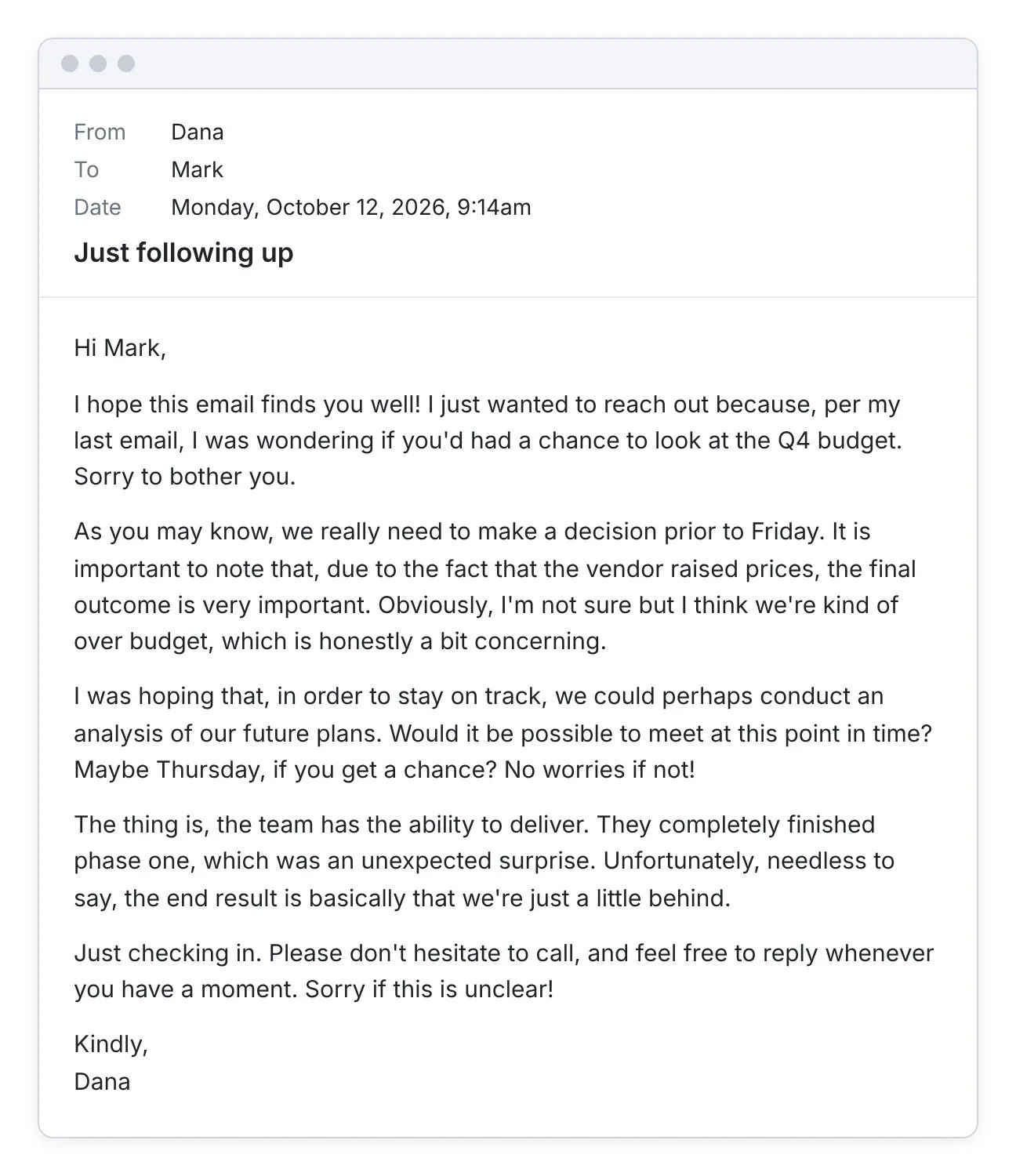
Be honest. What do you see?
Most people would see “I hope this email finds you well” and consider this spam, especially if they don’t know Dana.
But imagine you do know Dana. You work with Dana. You’re pretty sure Dana is trying to tell you something important. So you keep reading (ahem, skimming).
You see “I just wanted to reach out”...You think, Yep, got that. You emailed me.
You see “Sorry to bother you”...It’s ok, Dana. It’s your job to work with me on stuff.
You see “As you may know”...Probably don’t need to read this part…
You see “I was hoping that, in order to stay on track, we could perhaps”...Geez, Dana, are you trying to ask me out or something? What is so hard about this?
You see “The team has the ability to deliver.” That’s good. Then I probably don’t need to read this email.
You see “Just checking in.” Yep, nothing to see here except Dana taking an eternity to get to no point.
And now Dana is waiting patiently for an answer that is never coming. Because her message didn’t make it easy for Mark to understand what she wanted or that she actually wanted anything at all.
Here’s another version:
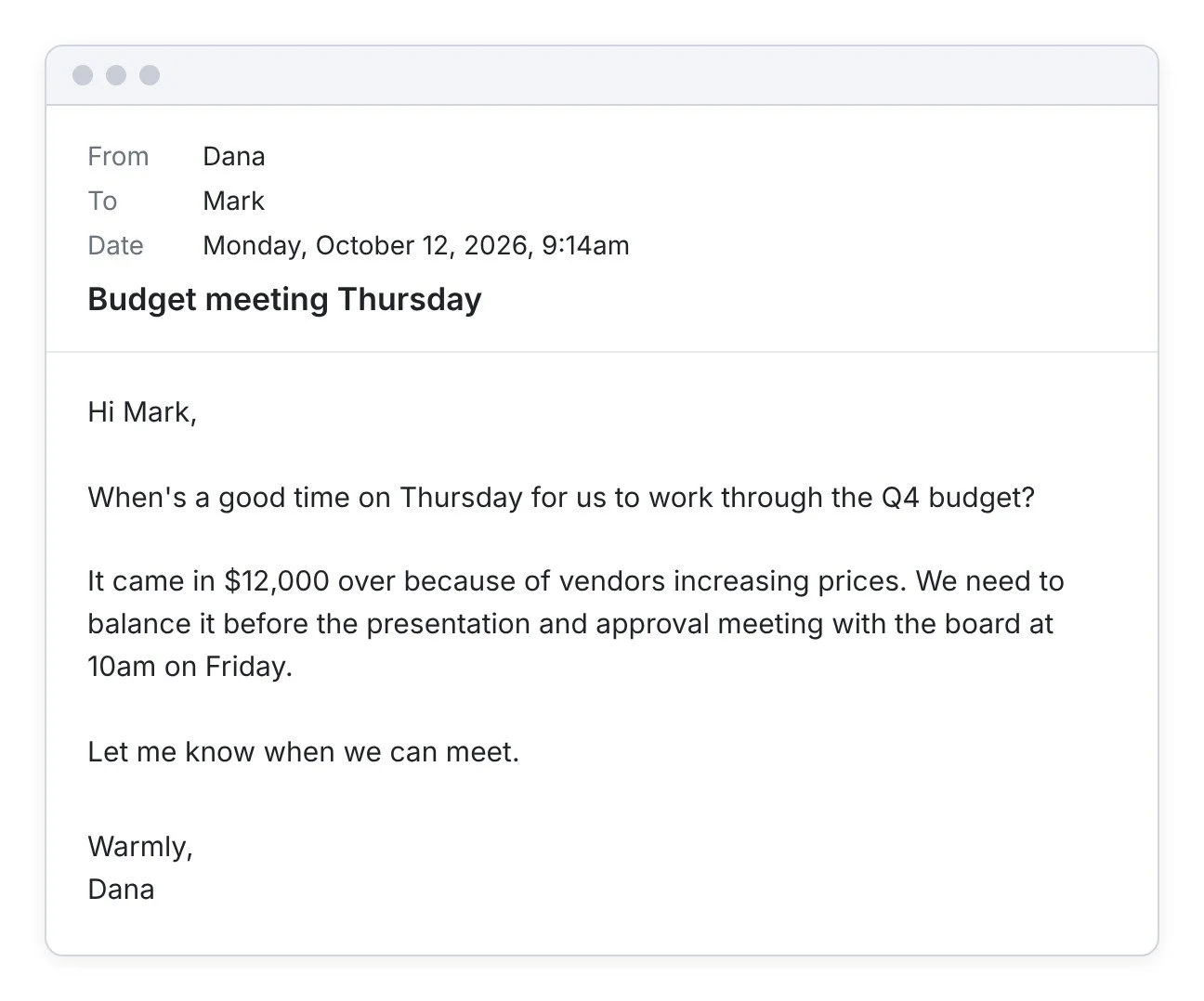
What about this one? What do you see? If you got this, would you know what to do?
Let me ask a really important question: Would you feel like Dana is rude because this message is so short and direct?
Probably not (unless there’s something you know about Dana that the rest of us don’t. And if that’s the case, please tell us!).
Assuming Dana is a solid coworker, this message is just “here’s work to do. Can you do it?”
People sometimes tell me that they want or need fluff in their messages. That without fluff messages don’t feel kind.
Um, really? Because that first message does not feel kind. It feels like Dana is not even aware of how much of my attention she is asking for and how much of my time she is wasting. Dana is a great person, but her writing doesn’t show me that she values me, my time, or my attention.
Of course, the first message is a massive exaggeration and probably (hopefully) no one you know would write that.
My point there is just that those phrases aren’t helpful. They are adding words, but they aren’t adding value. And the more you have, the less any of it works.
Since more words is what we learn in school, but more words isn’t actually useful at work, we have to unlearn the habit of more words. So I made you this list. Here are words you might consider taking out of your writing:
Words of emphasis
Really, very, just, only, quite, so, totally, truly, actually, literally, extremely, incredibly, absolutely, definitely, certainly, super, highly, deeply, completely, entirely, kindly
Phrases of explanation
I wanted to, I was wondering if, I was hoping that, I just wanted to reach out, I’m writing to, I thought I’d, I’d like to take a moment to, just checking in, just following up, per my last email, as you may know, as I mentioned, I hope this email finds you well, please don’t hesitate to, feel free to, it is important to note that, it should be noted that, the thing is, what I mean is
Words of judgment (often -ly)
Obviously, clearly, simply, basically, honestly, frankly, admittedly, unfortunately, hopefully, surely, of course, needless to say
Hedges and apologies
Sort of, kind of, a bit, a little, somewhat, perhaps, maybe, possibly, I think, I feel, I believe, it seems, in my opinion, I’m not sure but, would it be possible to, do you think you could maybe, if you get a chance, whenever you have a moment, no worries if not, not sure if this is possible but, sorry to bother you, sorry for the delay, sorry if this is unclear
Wordy and redundant phrases
In order to, due to the fact that, at this point in time, in the event that, with regard to / in regard to, prior to, a large number of, has the ability to, in close proximity, make a decision, conduct an analysis, is able to, the fact that, each and every, first and foremost, time period, end result, final outcome, past history, future plans, advance planning, basic fundamentals, close proximity, completely finished, unexpected surprise, revert back, true facts
You don’t have to take all of these out of your writing permanently. You don’t have to avoid them 100% of the time. Words and phrases exist in our language because they serve a purpose. If these words and phrases are serving a purpose–a real, legitimate, concrete, I-can-explain-it-to-my-mother-and-she’ll-not-only-understand-but-also-agree purpose–then you can use them.
But if these words are ending up in your messages out of habit, then identify the ones you use them most and work on letting them go. (And consider coming to my workshop on October 23 so we can talk more about habits and how they affect your writing!)