Spot the AI Tells
AI writing has patterns.
Many of those patterns are the result of all the human language that AI has been trained on. The patterns exist for a reason. It’s just that no human would ever use them all at once or repetitively, sentence after sentence.
It’s not the fact that AI uses these patterns that makes them “bad”. It’s the fact that AI has no judgment about when to use them.
For example, those two sentences I just wrote–”it’s not the fact that AI does x; it’s the fact that AI does y”--is exactly one of AI’s patterns. But I, a human, wrote it without thinking because the contrast helps me make a point.
But AI writing will do this over and over without realizing that doing it over and over might be a problem for the human reader.
AI’s Patterns
Here are the patterns to pay attention to:
“It’s not x, but y”
It’s not time, but money that affects the outcome.
Lists of threes
The goal is writing that is short, makes sense, and shows respect.
Two beat sentences
Our mission is clear. Our commitment is firm.
Heavy alliteration
Our customer care team is committed to consistent, caring service at every touchpoint.
Passive voice
The meeting was scheduled by the admin. Active would be this: The admin scheduled the meeting.
Anything—word or punctuation—that seems “fancy” or like it’s more impressive than whatever you were going to write.
Moving forward, we’ll leverage cross-functional synergies to drive impactful outcomes across the organization.
-ly words added for length and filler rather than meaning
I’m truly excited to share that our team has significantly improved response times, and we’re incredibly grateful for your continued support.
Examples to analyze
For example, here are a couple of short sentences that were written by AI to illustrate these patterns:
This isn’t just a project update — it’s a powerful pivot toward progress.
Our team brings passion, precision, and purpose to every partnership.
We listened. We learned. And now, we’re leveling up.
The plan is simple. The impact is not.
What do you notice?
The first one uses the “it’s not x, but y” pattern. It has an em dash, with spaces around the em dash. Most humans are lazy and don’t put the spaces in (look at my em dashes above 😆). It also uses excessive alliteration: “powerful pivot toward progress” is too many “p”s in a row–and don’t forget that it started with “project”--and most humans would find that a little strange or hallmark-y. And it has an unnecessary “just”.
The second one is more excessive alliteration using “p”. It also is a list of 3 things. People write lists of three things all the time. But we rarely fill a whole paragraph with sentences that are just lists of threes, and never lists that are also alliterative. And this sentence really doesn’t say anything meaningful or specific. It’s ok in a paragraph that gets into some details about what the team does or what success they’ve had or who their clients are. But if the phrases all sound like this–empty, repetitive, and grouped into very simple and consistent threes–well, that can be a sign of AI writing.
The third example uses that same three beat pattern, but now they are sentences. They use “l” for alliteration. And they still don’t say anything particularly concrete or insightful. They sound like something that would go on a billboard.
The fourth one uses another pattern, which is basically a simpler “it’s not x, but y” backwards and really, really short. Two beats is also common.
The clearest tell, though, is that you read something and there’s no mention of anything specific–no “one time this happened” or “yesterday I ran into so and so” or “Remember that intern we had for like two days?” The language is empty. It’s using words, maybe there’s even some information, but none of it is really interesting because it doesn’t sound like it’s coming from *someone*.
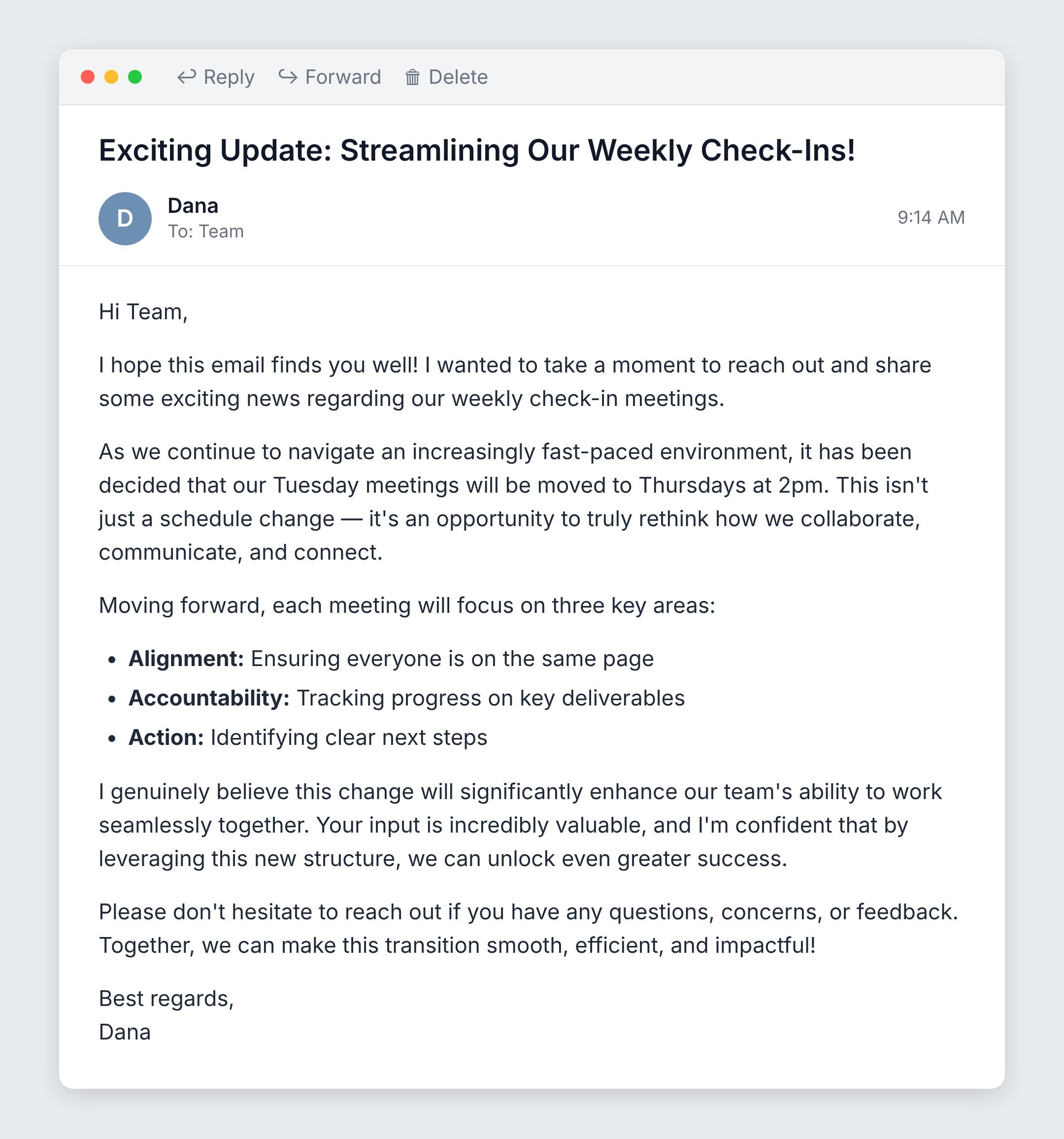
What tells can you find in this email?
Here’s my markup. In red, because AI doesn’t have feelings.
Here’s the list of the patterns with the evidence from the email:
“It’s not x, but y”: “This isn’t just a schedule change — it’s an opportunity”
Lists of three: “smooth, efficient, and impactful”
Heavy alliteration: “Alignment, Accountability, Action”
Extra punctuation: three exclamation points and an em dash
Fancy words: “leveraging this new structure”
Big, empty words: “I hope this email finds you well”
-ly words: truly, genuinely, significantly, seamlessly, incredibly (and increasingly)
Passive voice: “it has been decided” (by whom?)
“I” for thoughts and feelings: “I genuinely believe”
Two-beat sentences: none in this one, but you’ve seen them: “Our mission is clear. Our commitment is unwavering.”
And now, here’s all the email really needed to say:
The goal of using AI is to help us do our work faster, better. I’ve recently discovered that I make a lot of typos if I’m not using AI spelling and grammar tools. I’ve just gotten so used to them fixing my mistakes for me that I pretty much don’t think about it until something gets flagged. I have been using AI to help me make a LinkedIn post schedule, update my website so that everything is consistent, and proofread proposals that I’m sending to clients. These things still take me hours, but they are easier and less frustrating because AI can help me do the things I don’t already know how to do.
With one of my proposals, I wrote the content. I made all the decisions. AI made it look pretty because moving all those little details around on Canva will drive me insane. When I had it the way I wanted it, I told AI to do three separate review passes: 1) check for clarity, 2) check for any details or content that is missing or repeated, 3) check the grammar. And I said ask me any questions that come up as you are doing the reviews. It found errors and asked questions. I reworked the content and told it to do the 3 passes again. It did–and found *new* errors and asked *different* questions. I updated the proposal and asked for the passes to be run again. The AI said that it was confident the proposal was good. I said “we run the passes until nothing comes up”. It ran the passes again. We made changes again. I think it took 6 times for it to come back with nothing at all. It kept trying to give me the answer I wanted: that the proposal was ready. It didn’t understand that what I actually wanted was the best possible proposal.
And this is exactly why we have to be careful with how we are using AI to write. It uses our language, language that we invented and developed and used and honed and changed. But it uses that to create things that meet a certain set of expectations: grammatically correct sentences. But that don’t, when it comes down to it, actually communicate what we mean in ways that make the content stick in other people’s heads.
Remember, your language is as unique to you as your fingerprint. So it should sound like something only you could write: your words, your sentences, your stories. Just a little cleaned up because the AI tools helped you focus your ideas, write toward the purpose, adapt to your audience, and make sure your content was clear and correct.