What is AI writing good for?
Right now, AI writing assistance is popping up in everything we use. Do you want help writing that email? That text message? Taking notes in that meeting? Writing that insta post?
Personally, I reject almost all of it. Because I WILL LET AI KNOW WHEN I NEED IT. I don’t want it to prompt me.
But I know plenty of people are thinking, “Well, as long as it offered, I’d rather let it than do it myself.” And that’s valid too.
The difficulty is that AI looks like it can do a lot for us, but that impression of easy confidence is part of its programming. I’ve had AI offer to make me a powerpoint and then say, “Oh, sorry, looks like I can’t do that.” Well then why did you offer?
AI offers because it doesn’t know its limits. It doesn’t know what its capable of. In fact, it doesn’t know anything.
That’s not how it works. It doesn’t read. It doesn’t write. It doesn’t know or think or consider or feel or value or determine. AI doesn’t think.
It predicts.
What AI actually does is identify patterns in data. So, if you want it to find cancer on an x-ray, you feed it a bunch of x-rays that show healthy bodies, benign tumors, and cancerous tumors to give it enough information to generate a mathematical representation of the pattern of tumors. And then it can apply that mathematical representation (the algorithm) to look at new x-rays and predict whether they are healthy or show benign or cancerous tumors. And yes, the AI predictions are more accurate than human ones–because math. Not because the AI is smarter than the humans. It’s just a machine that identifies patterns and then reproduces patterns.
So now think about how that works–that same pattern recognition and regeneration–in writing. AI doesn’t know how to write. It doesn’t know what words mean. All it knows is that words have particular patterns of use and order. If someone starts typing “I’d go so far as”, AI and most humans can guess that the next part of the sentence is “to say that” because one group of words typically follows the other group of words. AI (and humans) can generate language based on patterns in the data on how humans use language.
The fact that AI can identify and replicate patterns is useful in writing. It can create complete sentences, proofread our work, help people working in their second or third language translate or sound more fluent. If we are trying to write something standard like a resume or a job description or a procedure, it can help us do that faster by replicating the standard language those formats typically use.
But because AI writes based on patterns, its language can sound very different from our own and almost like no one person wrote it. That’s because a person didn’t write it. AI writes based on what has been written before in the same set of circumstances. People write based a little bit on how other things are written, but mostly based on their own language experiences. Because AI writes in these patterns, it can flatten or remove your voice, make your writing sound different from you–which is generally not better.
Many people are seeing how fast AI can generate complete and correct sentences and feel like it is a “better” writer than they are. But that’s mostly because school taught us that correct writing was good writing.
With the development of spellcheck, grammarcheck, more recently Grammarly, and even more recently AI, we expect writing to be mostly correct because we know everyone has access to these tools. Correct writing is now average writing. Because correctness simply isn’t an important metric for whether the content is good or effective. In creative writing, good writing is something that connects with the audience but does so in a new and original way. So good is something that is novel, not something that matches previously established patterns.
However, in business writing, we are writing not for the beauty of the language or the story, but for the effect that our writing will have on decisions and outcomes made in the real world. The measure of good writing in business is not how correct it is or how unique it is, but how effective it is.
So here’s the problem. AI relies on patterns in the data to generate new content. If you ask AI to write an email, it will do it with a greeting and a closing and short paragraphs and a short overall length for the information. But it will also use language that is common for emails, even if that language isn’t effective.
For example, many people write emails with the first sentence (the first sentence after the greeting) saying “I hope this email finds you well.” People write this because they want to start the “conversation” in the email with a polite opener. Because so many people do this, AI tends to do it, too.
But no one–not a person, not AI–should be writing emails with that as the first sentence. (Ok, that’s my opinion, but lots of experts agree with me). It’s not “wrong” as in “incorrect”. It’s just not effective.
The first sentence of an email has been shown to be the sentence that most people read. In fact, it is the most read sentences of any message. That makes it the most valuable real estate in the message–the place where you have the best chance of communicating information to the reader.
So, if that’s your most valuable real estate, you should use it to tell the reader something important, useful, and relevant. Not to send the reader generic good wishes. That’s not effective.
Because AI is imitating humans who wrote all these messages using ineffective patterns, AI isn’t a better business writer than most humans. It might be faster. It might be more grammatically correct. But it isn’t better. It doesn’t know anything about business writing that the professionals I work with don’t know. The thing is, I want both those professionals and AI to write better (as in, more effective) business messages so that their messages get them the outcome they want faster!
The purpose of all of that is simply to remind you that AI is not a better writer than you are. It’s just a faster writer than you are. But it can still make mistakes, at lightning speed, and you still need to be responsible for the prompts that get AI to generate writing and how you use (and edit) the content AI produces.
AI writing can be useful because of its speed and ability to produce complete, correct sentences. But it doesn’t “know” anything without your prompt and your evaluation of the output.
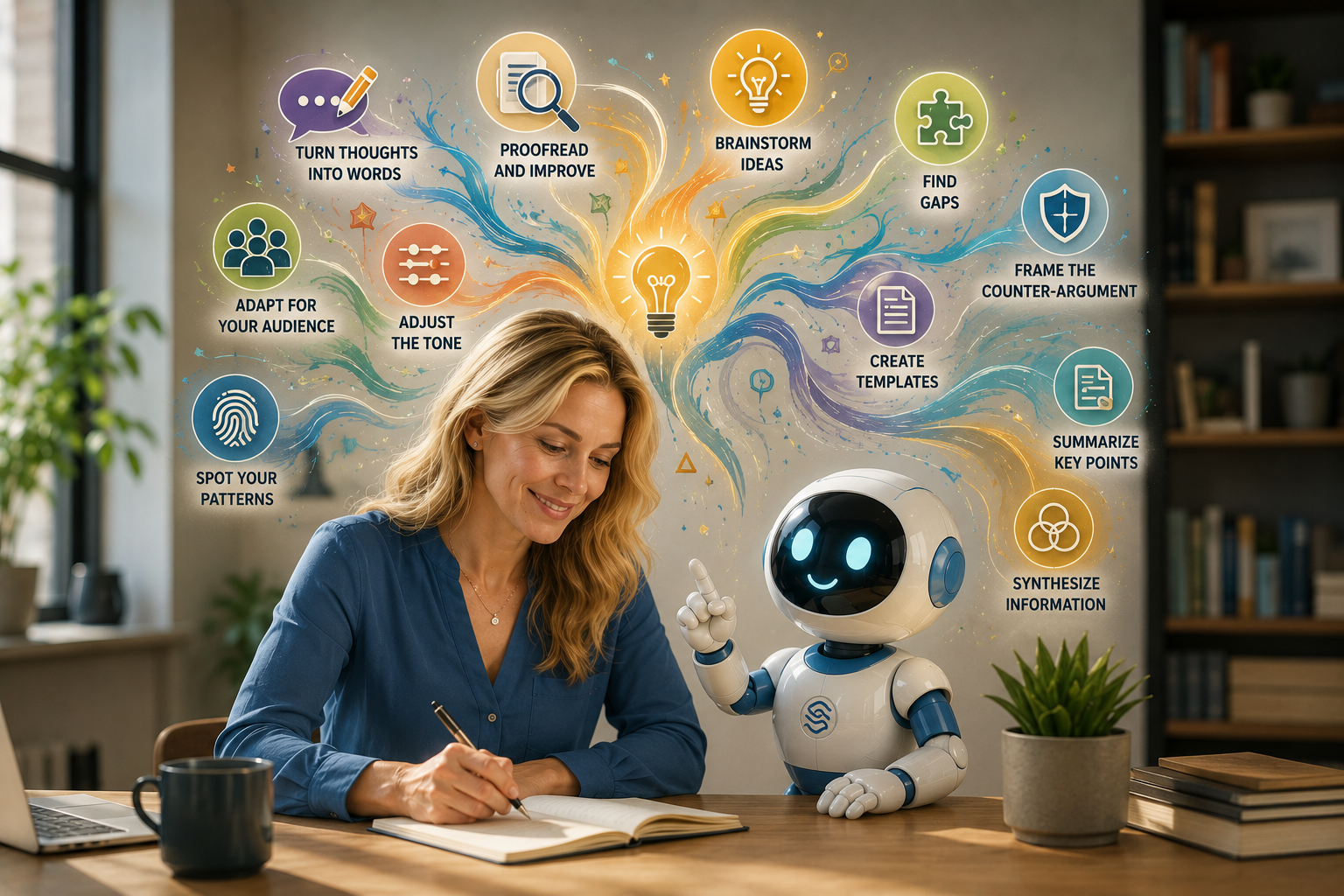
So, AI writing is helpful for doing things that are improved by sticking to the patterns. Things like these:
Turning your thoughts into complete (and correct) sentences–this can be especially useful if you have any challenges whether that’s imperfect typing skills, some sort of learning disability, or working in your second (or third) language. You can create imperfect content and AI can make it clear and correct.
Proofreading your own work–All of us, even professional editors, have trouble proofreading our own work because we typically don’t see what we actually wrote. We read what we *think* we wrote. That’s why editors are so important–they can see the places where we lost the thread, messed up the grammar, or used the wrong word. AI can do this for you, too (though be careful because AI doesn’t have all the context to decide what is *right*. It can point out what may be *wrong*).
Adapting something you’ve already written, whether to a new audience or for a new purpose or in a new format–maybe you wrote a report that needs to be condensed into one bullet point for a meeting. Maybe you wrote one bullet point that needs to be expanded into a report. If you have the content, AI is good at helping you change the parameters.
Templates–when you *want* to say things like everyone else, AI writing can help because it knows exactly how everyone else says it! And this is especially useful when it’s communicating information–procedures, policies, job descriptions, contracts–stuff that no human is voluntarily going to read in detail but if any human ever did, it all needs to be there and make sense.
The other thing that AI is good for is supporting the writing that we humans do! It doesn’t have to generate the writing for us, but it can help us clarify, improve, develop, and think through the writing that we want to create ourselves! And one of its most amazing advantages is that AI has infinite patience. You can ask it the same question 10 different ways or exactly the same way 10 times; you can get frustrated with its responses, disagree with it, yell at it, and make it do the same thing again but better, and it will just take it and continue generating responses. That’s because AI isn’t human: it doesn’t eat, sleep, or feel. So it doesn’t get tired or frustrated or angry or disappointed or despondent. It doesn’t get any of that. It just produces in response to your prompt and hitting “enter”.
With that in mind, AI can definitely support you in your writing by working as your assistant. Here’s what it can do:
Brainstorming–it has all the patience in the world
Finding gaps–it can ask you questions about what’s missing
Framing the counterargument–it can argue the other side so that you can make your argument stronger
Summarizing whatever you write back to you–you don’t even know what you’ve said but it does
Synthesizing–connecting your ideas to other things in the world or other ideas you’ve had
Helping you choose the appropriate tone–sometimes we write things when our emotions are high and AI can help you process and then revise to something that is probably safer to send
Spotting your own patterns–we might know some, but AI can track all the things and help us see our blindspots
AI is an incredible tool for doing a lot of things! But it is still just a tool. A tool is made by humans, for humans, and is used by humans. It doesn’t work independently of humans. This tool looks like it might be smarter than humans–and maybe in some ways it is since it has access to all knowledge with the push of a button–but it doesn’t actually “know” and it doesn’t “care”, so as long as those things are true, it is still just a tool that we humans can learn to use more effectively to help us do our work–it’s not yet time to just turn all of our work and thinking (and writing) over to the robot overlords.