How do you use the word "I" in your writing at work?
In April, I mentioned 5 tips for revising anything you draft with AI.
One tip was to edit the use of "I".
AI writing is generated based on patterns. Patterns that we humans created.
But a lot of the patterns in our writing at work are the result of language strategies that don't really work. Business communication has prioritized jargon, empty politeness, and archaic sentence structures that get passed down like old heirlooms ("I'm writing you because", anyone? We know you are writing! We are reading it!)
And those old, not-so-effective patterns get recreated in AI writing when you ask it to draft an email for you.
Which is why I recommend my professionals practice using "I" in particular ways and why I suggested last month that we make sure to edit AI writing for its use of "I", so that the word is serving our communication in the best ways possible--and not just because that's how people have always said whatever-the-thing-is at work.
For example, here’s an AI-generated email:
Hi Priya, James, and Suzanne,
I've received your messages and I appreciate that you're all looking out for me. However, I want to be very clear: I have planned this launch carefully, and I am perfectly capable of handling the marketing and the rollout on my own. I've spent my career being self-sufficient, and I'm not about to stop now. I'm looking forward to this venture and building the business I've wanted to build for a long time.
I've attached a document with my launch dates and the contact details of the vendors I'll be working with, just so you have them for your records.
I'm going to have a great success, and I'll check in when I feel like it.
Best,
Derek
Look at all those “I”s!!
I’ve received
I appreciate
I want
I have planned
I am perfectly capable
I’ve spent
I’m not about to stop
I’m looking forward
I’ve wanted to build
I’ve attached
I’m going to have
I’ll check in
I feel
This whole message is about Derek and what Derek wants and needs and thinks and all those “I”s just emphasize how much Derek is thinking about Derek and not about Priya, James, and Suzanne at all.
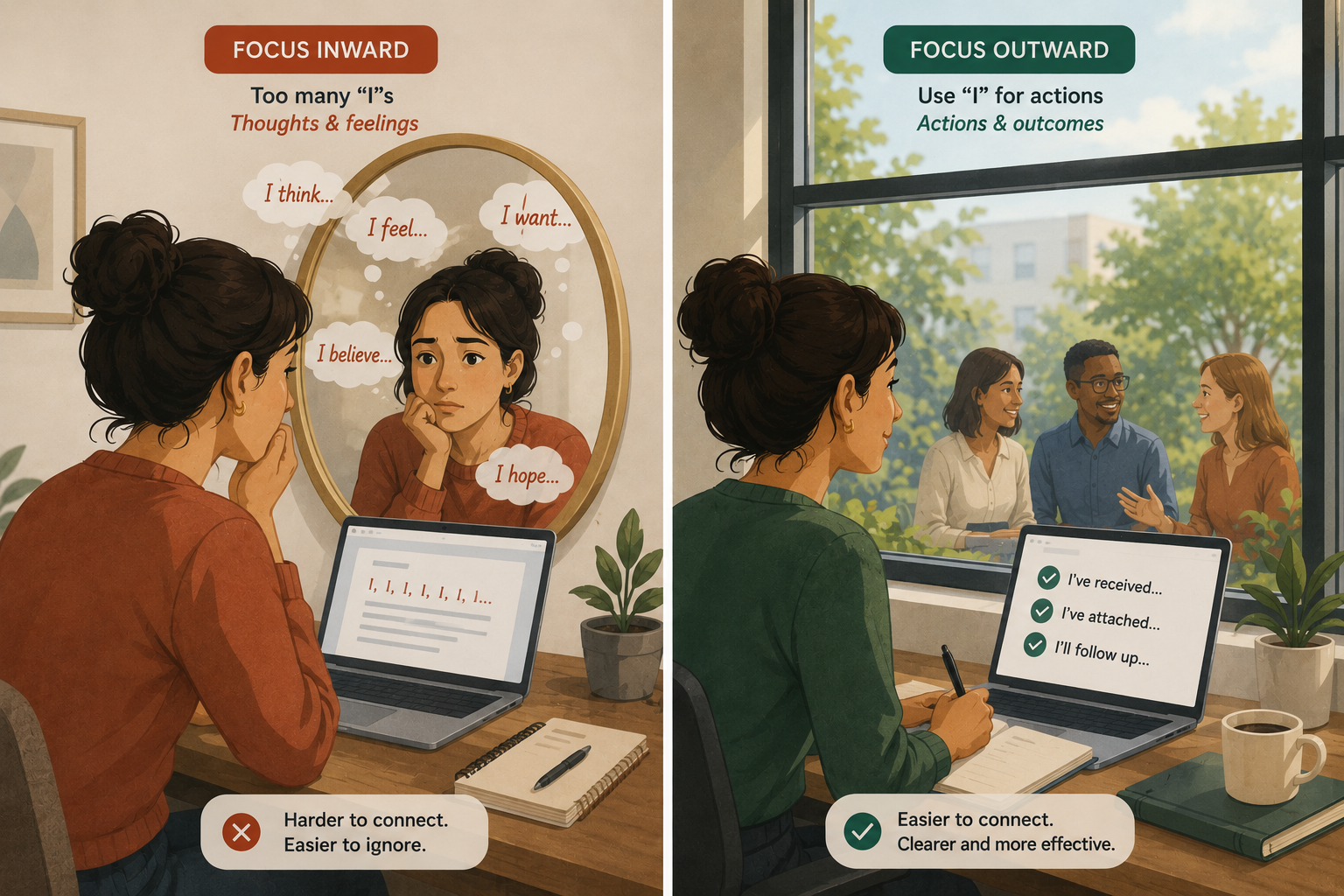
My suggestion is to use “I” for actions but remove “I” for thoughts and feelings. So let’s apply that to the list and revision:
I’ve received (action ✅)
I appreciate (thought/feeling ❌)
I want (thought/feeling ❌)
I have planned (action ✅)
I am perfectly capable (thought/feeling ❌)
I’ve spent (thought/feeling ❌)
I’m not about to stop (thought/feeling ❌)
I’m looking forward (thought/feeling ❌)
I’ve wanted to build (thought/feeling ❌)
I’ve attached (action ✅)
I’m going to have (thought/feeling ❌)
I’ll check in (action ✅)
I feel (thought/feeling ❌)
I’ll be working with (thought/feeling ❌)
Now, to be clear, there are other problems with this message (Tone? 😬). But look at what happens to the message (and the tone) when we start taking “I” out:
Hi Priya, James, and Suzanne,
I've received your messages and understand that you're all looking out for me. However, I have planned this launch carefully and will handle the marketing and the rollout because building this is exciting for me!
I've attached a document with the launch dates and the contact details of the vendors, so you have them for your records.
I'll check in soon.
Best,
Derek
What happens when we remove all the thought and feeling-related “I”s? Well, you can see for yourself! The tension is still there in the “however” and the clear determination to do the launch alone. But the poutiness has (almost) disappeared and it is not a simple statement that Derek is handling it and has shared the info that Priya, James, and Suzanne would find necessary.
This version follows the rule almost perfectly and keeps these “I”s:
I’ve received (action ✅)
I have planned (action ✅)
I’ve attached (action ✅)
I’ll check in (action ✅)
So the “I”s for actions remain, while the “I”s for thoughts and feelings have been removed. Notice, though, that “I” is still the first word of all three paragraphs. The fact that “I” is first on all 3 lines still creates that emphasis.
(ADVANCED “I” use: Shift “I” to me or start sentences with other subjects so that “I” comes later in the sentence)
Now, is this the email I would recommend? Not quite.
But it is MUCH closer to what we want than the first one!
If you want to know what I would write, here it is:
Hi Priya, James, and Suzanne,
Your messages show how much you're all looking out for me. However, planning this launch has been a rewarding challenge for me, and I’m handling the marketing and the rollout as the next steps in that work.
Attached are the launch dates and the contact details of the vendors for you.
This is such an exciting venture, and I’m determined to make it successful!
I'll check in on Tuesday to confirm that everything is ready to go.
Best,
Derek
So, I have kept 3 “I”s:
I’m handling (action ✅)
I’m determined (thought/feeling ❌)
I’ll check in (action ✅)
Why do I get to keep one thought/feeling “I” when I’m recommending you take them out? Because this version cuts the “I”s to 3, so there’s more leeway with the “I” when you have so few of them. The rule (guideline? suggestion?) is to help you find places where I can (should?) be removed. But the goal is not to create a strange, impersonal message that sounds like it came from no one or that the writer doesn’t care about anything!
The goal is to create a message that has a balanced conversation between the writer (“I”) and the reader (“you”), that has a positive tone, and that is easy to skim.
But it can be hard to do all those things at once without a lot of guidelines (rules?) and practice!
Once you start paying attention to where that “I” pops up, you’ll get better at thinking of ways to revise it so that your writing is more audience (“you”)-focused and easier for that audience to read.